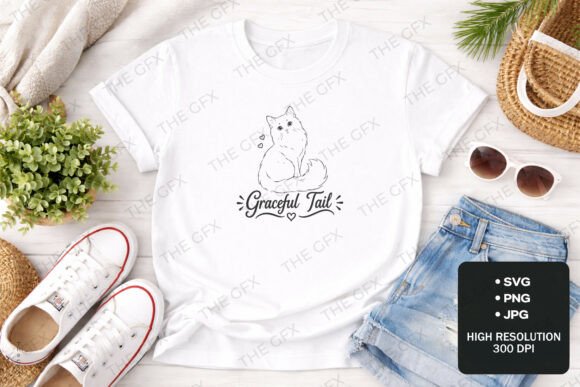
Graceful Tail Cat Line Art Design
A Designer’s First Look: Simplicity That Speaks Volumes
When I opened Graceful Tail Cat Line Art Design, my first thought wasn’t “cute” — it was “calm.” There’s a quiet confidence in its minimalism: one continuous, fluid line tracing the curve of a cat’s spine, the gentle arch of its neck, and the soft sweep of its tail. No eyes, no whiskers, no shading — just poise distilled into contour. As an embroidery designer who’s stitched hundreds of feline motifs, I appreciate how this avoids cliché while still feeling unmistakably *cat*. It doesn’t shout. It invites pause. That makes it unusually versatile — not just for T-Shirt Designs, but for any handmade product where subtlety signals intention.
Real-World Test: Embroidering It on a Linen Tea Towel
Last week, I used Graceful Tail Cat Line Art Design for a small-batch kitchen towel order — natural linen, medium-weight, with a subtle weave. I chose a 40-weight cotton thread in charcoal gray and ran it as a clean running stitch at moderate density. The result? Crisp, graceful, and surprisingly tactile. The line held its integrity across the fabric’s slight texture, and because the design avoids tight corners or micro-details, there was zero puckering or skipped stitches. Customers later told me the towel felt “thoughtful,” not decorative — exactly the tone a boutique kitchen brand wants. That’s the quiet power of this design: it elevates the object without overwhelming it.
Where It Shines (and Why)
- Custom apparel: On a lightweight cotton tee or relaxed-fit sweatshirt, it reads cleanly at 3–4 inches wide — large enough to be seen, small enough to feel intentional.
- Embroidered patch: Its open, uncluttered shape translates beautifully to woven or chenille patches. No fill stitch needed — just clean satin or running stitch edges.
- Baby embroidery: Ideal for onesies or burp cloths — soft, non-distracting, and gender-neutral in spirit.
- Holiday embroidery & personalized gifts: Pair it with a simple monogram or date on a pillow cover or apron — elegant, timeless, never dated.
- Etsy seller & small shop product: Works exceptionally well in printable mockups. Looks equally strong on light and dark backgrounds, which saves time when prepping listings.
Where to Proceed With Care
This isn’t a one-size-fits-all embroidery file. Its strength is also its limitation: minimalism demands precision. Here’s where attention matters:
- Small hoop sizes (under 4”): The tail’s taper can become too fine — test stitch density and thread thickness before committing to a 2.5” hoop.
- Textured or stretchy fabric: On slubbed knits or ribbed cotton, the single-line flow may break visually. A light tear-away stabilizer helps, but always test on scrap first.
- Dark fabric: Since it’s line art, contrast relies entirely on thread color. Avoid pale pastels on navy or black unless you’re using metallic or high-sheen thread.
- Curved surfaces (caps, curved tote handles): The continuous curve works *with* the shape — but only if hooping is precise. Misalignment shows more here than in a busy fill-stitch design.
- Frequent-wash items (baby clothes, tea towels): Confirm stitch density supports durability. Too sparse = fraying over time; too dense = stiffness. Aim for balanced tension.
What It Does for Your Craft Business
Graceful Tail Cat Line Art Design quietly raises the perceived value of your finished product. It doesn’t scream “handmade” — it whispers “carefully made.” That builds customer trust faster than ornate motifs, especially among buyers who prioritize aesthetics over novelty. For Etsy sellers, it’s a reliable anchor design: easy to style in photos, adaptable across seasons, and recognizable without being overused. As a digital embroidery file, it pairs well with complementary assets — think minimalist paw prints or delicate botanical stems — letting you build cohesive design sets without visual fatigue.
Practical Designer Notes Before You Stitch
- Always run a test on scrap fabric that matches your final project’s weight and texture.
- Check thread color contrast in both natural and artificial light — grayscale mockups reveal clarity issues early.
- Review stitch density: too low risks fragility; too high adds bulk that fights the design’s lightness.
- Confirm hoop size compatibility — especially if layering with text or other elements.
- Inspect corners and endpoints: does the tail end cleanly, or does it feather or double-back?
- Use appropriate stabilizer — cutaway for knits, tear-away for stable wovens like linen or canvas.
- Verify licensing terms before selling finished items or bundling the digital embroidery file — commercial use isn’t automatic.
Final Thought: Not Just a Cat — A Quiet Signature
I’ve passed on dozens of “cat-themed” embroidery files — too literal, too busy, too trend-dependent. Graceful Tail Cat Line Art Design is different. It’s not about depicting a cat. It’s about capturing a feeling — grace, stillness, presence — in a way that serves the product, not the motif. Whether you’re stitching a custom embroidered tote bag for a local café, prepping holiday embroidery for a craft fair, or building a signature look for your small shop, this design earns its place. It doesn’t distract. It dignifies. And in handmade work, that kind of restraint is rare — and deeply valuable.