Cute Cat Line Art Poses Vector
First Impression: Clean, Charming, and Surprisingly Versatile
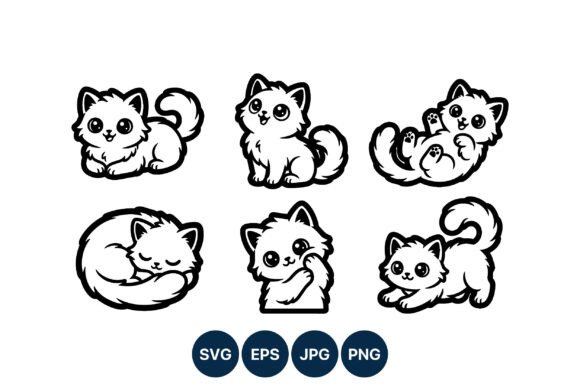
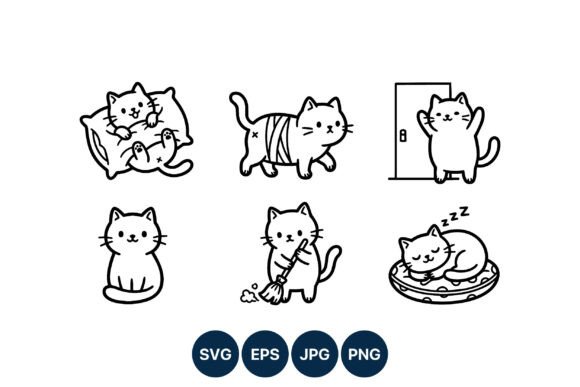
When I opened Cute Cat Line Art Poses Vector, my first thought wasn’t “cute”—it was “usable.” As someone who’s stitched hundreds of designs across apparel, baby items, and boutique merchandise, I’ve learned that charm without clarity rarely survives the needle. This set delivers six distinct feline poses—lying on a pillow, bandaged walking, standing by a door, sitting, sweeping, and sleeping on a bed—all rendered in crisp black-and-white line art. There’s no shading, no gradients, no filler. Just confident, rhythmic strokes with gentle curves and intentional negative space. It feels like a sketchbook page you’d want to frame—but more importantly, it feels like a design that will translate cleanly into thread.
Real-World Test: A Custom Embroidered Tote for a Local Bookstore Pop-Up
Last week, I used one of the poses—the cat sitting upright, paws neatly together—to embroider a limited-run canvas tote for a neighborhood indie bookstore’s “Cat & Chapters” event. We chose a natural unbleached cotton tote, medium-weight, with light texture. The line art held up beautifully: no lost corners, no fragile joins, no awkward tapering where limbs met bodies. Because the lines are consistent in weight (roughly 1.5–2pt equivalent), the stitch-out stayed legible even at 3.2 inches tall—our sweet spot for front-of-tote visibility. Customers responded immediately—not just to the cat, but to how *intentional* it looked. That matters. In handmade product spaces, perceived care builds trust faster than any tagline.
Where It Shines (and Why)
- Custom apparel: Works exceptionally well on sweatshirts and crewneck tees—especially when placed on left-chest or sleeve. The simplicity reads clearly from across a room, and the lack of fill areas keeps stitch time low and stabilizer needs manageable.
- Baby embroidery: The sleeping-on-bed and lying-on-pillow poses are ideal for onesies and swaddle blankets. Gentle curves read as soothing, not busy—and because there’s no fine detail (like whiskers or pupils), they avoid looking muddy on lightweight knit fabrics.
- Embroidered patch: These vector poses convert cleanly to applique designs. I tested one as a raw-edge patch on denim—cut cleanly, fused smoothly, and stitched with a tight satin border. No puckering, no distortion.
- Holiday and gift embroidery: The bandaged-walking cat? Unexpectedly perfect for “get well soon” baby blankets or “new pet” greeting cards turned into embroidered tea towels. It adds narrative without clutter.
- Etsy seller & small shop product: As digital embroidery files, these poses let you offer mix-and-match options—e.g., “Choose your cat pose + name” for personalized nursery decor. The line art style scales gracefully from 2-inch hoop sizes (for iron-ons) up to 5-inch placements (on pillow covers or aprons).
Where to Proceed Thoughtfully
This isn’t a one-size-fits-all embroidery file—and that’s a strength, not a flaw. Here’s where attention pays off:
- Small hoop sizes under 2.5 inches: Avoid placing the “standing by a door” pose (tallest and most vertical) in tiny hoops—it sacrifices legibility. Opt instead for the sitting or sleeping poses, which compress gracefully.
- Textured or stretchy fabric: On slubbed linen or lightweight jersey, test the “sweeping” cat first—the broom handle and extended tail demand clean registration. Use cutaway stabilizer and reduce top tension slightly.
- Dark fabric: Since this is line art, contrast relies entirely on thread color. Black thread on navy won’t pop. Go bold: cream, mustard, or soft sage gives warmth and readability without needing metallics.
- Curved surfaces (caps, hats): The “bandaged walking” pose has subtle diagonal motion—great for side panels—but avoid placing it over deep crown curves unless you’re using a cap frame and dense stabilizer.
- Frequent-wash items (kitchen towels, baby bibs): Stick to running stitch or satin outlines—avoid dense fill stitches. The design’s inherent openness means it doesn’t need them anyway.
Design Integrity Meets Commercial Practicality
What makes Cute Cat Line Art Poses Vector stand out among Illustrations and Graphics isn’t just its aesthetic—it’s how it supports your workflow and brand voice. As a craft business owner, you’re not just stitching cats—you’re communicating playfulness, tenderness, or quiet joy. This set does that without shouting. It pairs effortlessly with minimalist branding, vintage typography, or soft color palettes. And because it’s vector-based, you can adjust stroke weight slightly pre-digitizing to match your machine’s sweet spot—no pixelation, no guesswork.
I’ve seen too many “cute” embroidery files fail at scale: thin lines disappear on terry cloth, overlapping limbs turn into thread nests, or whimsical details vanish after three washes. Cute Cat Line Art Poses Vector avoids those pitfalls by design—literally. Its deliberate spacing, balanced proportions, and restrained detail level make it forgiving for beginners and reliable for pros.
Essential Embroidery Designer Notes Before You Stitch
- Test the chosen pose on scrap fabric matching your final project’s weight and texture.
- Check thread color contrast in both natural and artificial light—especially for baby or nursery items.
- Review stitch density: line art should run lean. If your digitized version adds unnecessary underlay or fill, simplify it.
- Confirm hoop size compatibility—some poses work best centered; others benefit from slight rotation for better fabric clearance.
- Inspect small junctions (e.g., where tail meets back) at 200% zoom in your embroidery software.
- Mock it up in black-and-white first—this reveals balance and silhouette strength better than color ever will.
- Compare performance on light vs. dark fabric backgrounds using printable mockups before listing on Etsy or your shop.
- Use appropriate stabilizer: tear-away for stable wovens, cutaway for knits or towels.
- Verify licensing terms—especially if you plan to sell finished products or bundle the design into digital embroidery kits.